Showing posts with label landscape. Show all posts

Monday, August 12, 2013

One year in Norris

This month marks one year for me as a resident at the New Norris House. As a previous resident of various apartments near the center of Knoxville, one of the most interesting aspects of living in Norris has been the increase in time I’ve spent outdoors and the animals I’ve happily encountered along the way.

One frequent visitor is the brown snake. I’ve seen several of these (or maybe it is the same one?) around the landscape this summer. They are friendly snakes and don’t mind to be picked up and relocated away from the main walkways to the terraced gardens.

Brown snake, Storeia dekayi
While weeding the perennial bed this nest of small eggs was discovered. I had noticed several dozen juvenile five-lined skinks in the area. A little online research indicates that these are five-lined skink eggs.
Five-lined skink (Plestiodon fasciatus) nest

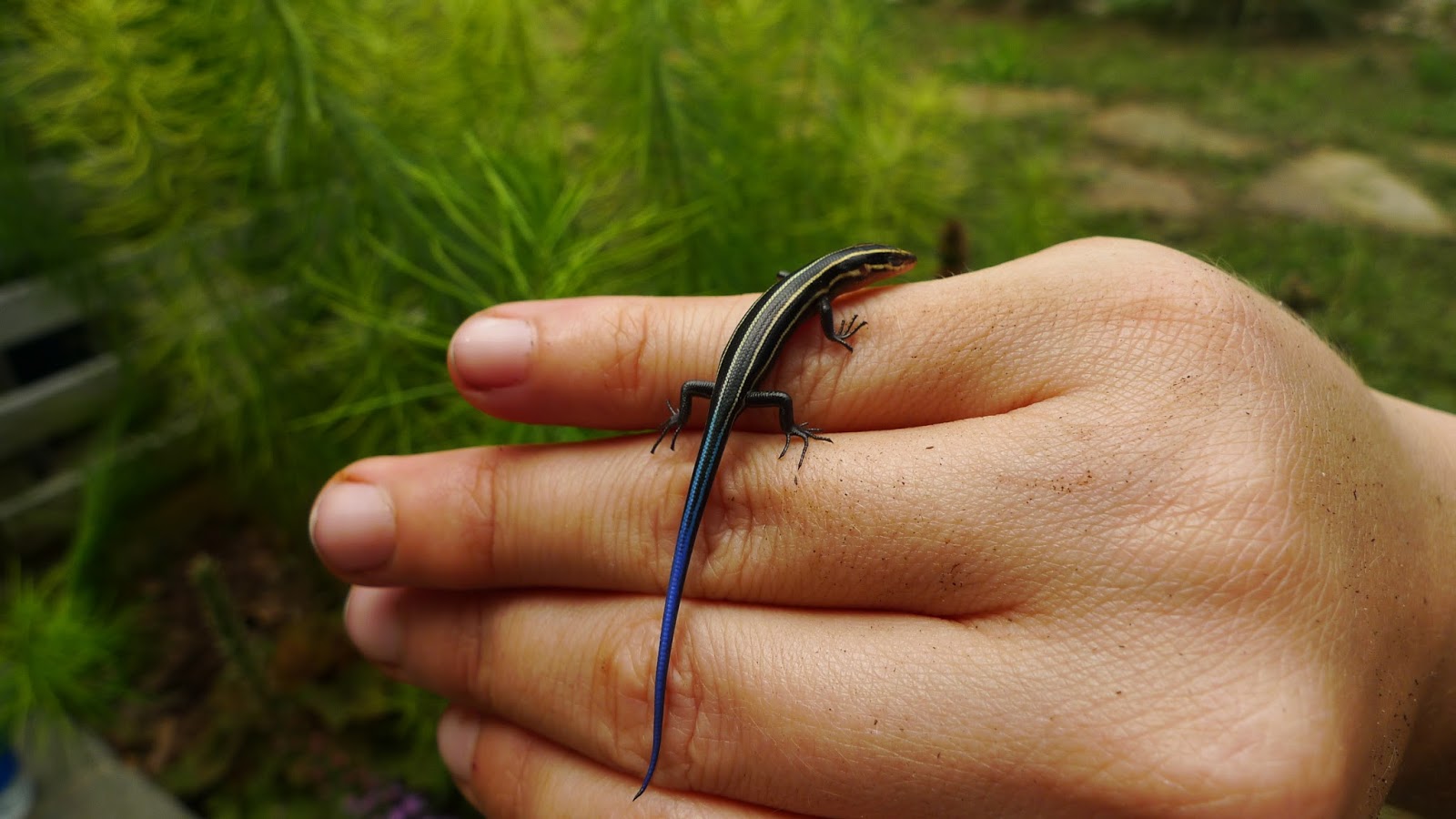
A juvenile skink found nearby sunning on top of the retaining wall.
Everyday, hundreds of bees, flies, dragonflies, and butterflies visit the rainwater and greywater beds and the meadows and perennial beds. The black-eyed susan’s and purple coneflowers are a favorite as well as the nodding onions and the passionflower vines, which are frequented by big, buzzing bumblebees.

The animals seen on a regular basis in the New Norris House landscape are not rare or threatened in East Tennessee, but every time I see one of them it brings a sense of joy and wonder to my day. However, it seems that it is becoming increasingly difficult to find these animals in many urban and suburban residential yards. Additionally, there is a growing body of research indicating that humans, especially young people, are not spending enough time outside engaged with plants and animals.

Fortunately, landscape methods, such as pesticide-free gardening with native plants and establishing small patches of native grass meadows as a lawn alternative, can create habitat for these and other species in urban and suburban yards. Native plantings are easier to care for than many non-natives because natives have evolved defenses against local predators and adaptations to thrive under local weather patterns. The reason native plants attract so many beneficial species of wildlife is also because they evolved together – with the plants providing food and shelter in return for species-specific relationships with the animals that pollinate or spread their seeds.

The New Norris House landscape is an example of how alive a suburban residential yard can feel.


Friday, May 25, 2012

Sponsor Spotlight: Room and Board


We've been looking for the perfect chairs to make the gravel plinth more inviting, and we finally found them! 

Thanks to our gracious sponsors at Room and Board, we are getting two Emmet Lounge Chairs! These chairs are made in America by Loll Designs. The chairs are 100 percent recycled high-density plastic, making them a perfect fit for the sustainable goals we strive for at the New Norris House. Check back soon for pictures of the chairs in use!

For more than 30 years, Room & Board has focused on the simple idea that good design should be beautiful, affordable and long-lasting. We work closely with American artisans to offer furniture and accessories-even custom pieces-that fit the needs of modern life. We're proud that more than 90 percent of the products we sell are handcrafted in the U.S. to give customers the best combination of quality and price. www.roomandboard.com

Monday, May 7, 2012

Meadow Planting Day and landscape photos

This weekend we planted the first half of our native grass meadow. The plan goes like this: 1) to suppress weeds, spread cardboard and staple to the ground with landscape staples 2) mark the plant locations on 2' centers 3) dig, dig, dig 4) plant, water and wait.

This is a slightly experimental meadow project. We are in a residential area, so the typical preparation of burning the plot of land to be planted with meadow grass seeds was out of the question. We will keep you posted on the (hopeful) success of this project!

Digging through the cardboard. It rained that morning which helped make the cardboard easier to cut through.

We are planting the meadow on the steeper parts of the site to help control erosion.

The volunteers are making great progress installing River Oats (Chasmanthium latifolium) in the shadier parts of the site. Isn't the cabbage getting big?

River Oats planted along the shady plinth edge.

Before leaving for the day we made sure to water everything, including the vegetable garden we planted a few weeks ago. Phil is using harvested rainwater to fill up the watering can.
The tomatoes in the raised vegetable beds are doing great.

The plants in the greywater bed are HUGE and it is only May. I think they must be happy.

Thank you so much to all the volunteers that came out to help this weekend! We planted over 400 plants and couldn't have done it with out you!

Sunday, April 1, 2012

Very Local Produce

Clearing the community path and separating seedlings
Nothing feels more like Spring than planting a garden, and at the New Norris House that's exactly what happened this weekend. Mary, Eric, and I spent some time doing general yard maintenance, and we also planted the raised vegetable beds. The beds were designed and built by students last summer, and we used stockpiled dirt from the house foundation excavation to fill the beds. We also added any vegetative waste produced from clearing the invasive plants, and let the soil sit all winter long. Now it is a beautiful, rich soil filled with worms and ready to produce!

We planted rainbow swiss chard, red cabbage, cauliflower, heirloom tomatoes, eggplant, peppers, carrots, fennel, arugula, gourds, and cucumbers. We also planted zinnias for cut flowers and to attract pollinators. In a few months we should have a huge harvest. Keep your fingers crossed and maybe we can add a County Fair Biggest Vegetable Award to our accomplishments!

We began by properly spacing all the plants before digging any holes
See the rich, dark soil under the hay?
As part of our efforts to collect and re-use the rainwater that falls on our site, our vegetable beds will be irrigated via a 200 gallon cistern located at the low end of the beds. The irrigation cistern is currently full of rainwater and ready to be used. We're looking forward to a summer of sustainable farming - right in the backyard!


Tuesday, March 13, 2012

Phase IV Landscape

In East Tennessee, the last expected freeze date is April 15, but it already feels like spring! With the warmer weather approaching it's time to start making preparations for the installation of the Phase IV landscape - the native grass meadows. Be sure to look for an upcoming post outlining the process we will use to establish the meadow (item number 6 on the site design plan below). For now, let's take a look at where we've been and where we are going with the New Norris House Landscape. 

BEFORE: Existing Site Conditions
While the existing house sat on an original Norris Cottage foundation, several remodels and years of vacancy left the house in poor condition. Original to the 1930’s town plan, two drainage swales, one stonelined (01) and one vegetated (14), flank the site. Our goal of treating stormwater onsite involves capturing and infiltrating water before it enters the swales.

AFTER: Site Design Plan
The site design responds to the linear site with a series of parallel interventions reflected in the plantings, community path, and raised vegetable beds. The steep slope is addressed with five terraced bioretention beds that treat greywater and rainwater. Native grass meadows and spreading shrubs are planted for erosion control and provide stormwater infiltration zones. The retaining wall delineates the previous homes footprint, and provides a pre-compacted area for the gravel parking court.

Site Design Section
The site section reveals the various ecological functions of the design such as infiltrating stormwater, treating greywater and rainwater, and restoring native habitat. The section also communicates the visible and physical connections between inside and outside. The program includes raised vegetable beds for producing fresh vegetables, level lawn area for recreation, and the forest edge plinth and fire pit, a retreat.

View of vegetable beds and gravel plinth from community path. Photo credit: Ken McCown

Friday, December 30, 2011

Happy New Year!

The year 2011 is drawing to a close, and a short reflection back on our first few months in the New Norris House reveals what we learned and what happened during that time. Similar to any new residence, there was a period of familiarizing ourselves to the house and the systems inside it. Some things in the house were brand new to us (the heating and cooling units, the rainwater cisterns, the solar hot water, and the small refrigerator and freezer), while others were familiar but required an adjustment (low flow faucets and shower, cabinet and storage configurations, and the furniture).

rainwater cistern in backyard (on flickr)
The house was ready for occupancy on July 1, and the finishing touches were completed throughout July and August. We set up our post office box and internet service, and enjoyed meeting people who came by for house tours over the 4th of July weekend. Students wrapped up their work on the yard and rainwater garden, and seeded the lawn. Kinks with fluctuating water temperature in the shower were worked out, and the solar hot water heater was installed. Railings on the deck and entry were leveled and secured. Temperature and humidity sensors were installed throughout the house. We became familiar with the air conditioning unit manual as we figured out the ideal way to run the systems in the summer heat.

the house in december (on flickr)
The official ribbon cutting ceremony for the house was in August, and hundreds of people attended and toured the house. Also that month, there were multiple media events to promote the finished project within the Norris and Knoxville areas, and at the University of Tennessee as well. Professors Tricia Stuth and Bob French, along with the student researchers and other student participants, have been a pleasure to work with during this experience. We've appreciated their patience with us while we went through learning about the house.

In the next six months, we’re looking forward to some new activities, including starting a garden in the raised beds in the backyard and exploring more of the Norris area. Until then, we wish you a Happy New Year!

Wednesday, November 16, 2011

Fall Volunteer Planting Day


When it comes to adding new plants to your landscape, most people think spring is the best time to plant. While some plants do well when planted in the spring, many plants, including trees and woody shrubs, benefit from fall planting. Trees and shrubs that are installed in the fall ultimately grow better because they have better conditions for root growth. In the fall, cooler atmospheric temperatures and decreased daylight hours signal the plant to stop growing above ground. Because the plant is not using as much energy to grow leaves and stems it has more energy to invest in root growth. Even though fall air is chilly, the ground remains relatively warm, and this further encourages root development. The roots continue to grow until the ground freezes, and in the spring root growth resumes or increases at an accelerated rate. Spring installed plants are at a disadvantage because their initial root growth is occurring in cool soils, while fall installed plants already have a well developed root structure. Well developed roots become increasingly important as cool, rainy spring weather gives way to hot, dry summer - a plant with well developed roots is much better equipped to deal with heat and drought then a plant that has a short and shallow root structure.

This past weekend we held a volunteer fall planting day at the New Norris House to complete the Phase II planting of trees and shrubs. We installed 55 shrubs to stabilize the slopes and provide food and habitat for wildlife.


We also planted 9 trees to provide buffer zones between our property and the adjacent properties. We planted 1 large dogwood in the front lawn as an accent tree. As the dogwood grows taller it will develop a horizontal branch structure that will frame the front large window.


The weather was perfect for digging and planting, and we had about 20 volunteers come to help. The day was a great success and we were able to install all the plants before lunchtime!

Thank you to all of the volunteers and Little River Nursery for providing the plant materials and donating the dogwood tree!

Friday, November 4, 2011

Fall color, inside and out

Autumn is here, and leaves are turning and falling. The riot of color outside changes a bit every day. Brown, red, rust, orange, yellow, and ochre leaves are mixed with green grasses and shrubs, and collect in piles when they fall.

from green to red to orange to yellow
Last week as I stood on the deck and looked at the trees in the back, it struck me that the colors used in the house are perfect complements to the colors in the fall landscape. Although white is the predominant paint color in the house, there are two other colors used on walls that can’t be seen from the main living area. The bedroom and bathroom each have an accent wall in golden yellow, and the swing space and loft each have an accent wall in reddish orange. Both colors match leaves hanging on to some of the trees around the house; the visual continuity of the outdoor and indoor is pleasing to the eye.

bedroom & bathroom
swing space & loft
Because the colored walls are balanced by white walls, the light coming in through the windows creates a reflection of that color on opposite walls. The photo below shows the effect—the only wall that is painted is the one down the middle, and the color faces the left. The light entering the skylight on the right has a much cooler tone since it is reflecting off a white wall. (View the original photo here.)


The furniture cushions and pillows are a light leafy green and buckskin, with one pillow in a contrasting reddish orange fabric similar to the paint color. The floor and kitchen counters are made of wood, with the floor a red oak and the counter a lighter more yellow oak. Houseplants have leaves ranging from chartreuse to dark green. Tile in the entryway is blue slate (although not visible from the house, reminiscent of the expanse of water on Norris Lake). All these interior colors have easily identifiable foils outside, and bring nature into the house this autumn.

furniture cushion
red oak floor
entryway tile

Monday, October 17, 2011

Phase IV Water Monitoring


Now that our water systems are up and running, it's time to begin the monitoring and analysis process. My task as a graduate assistant is to formalize a sampling and analysis protocol for testing water quality on both the supply side and the waste water side.

A little about me: My name is Valerie Friedmann and I am in my third year of studies as a graduate student in landscape architecture at UTK. My role in the New Norris House project began as a landscape architecture student consultant in the spring of 2010. I began by refining the conceptual landscape design, and continued working on the project to see it through the construction and installation phases. Last summer, I worked with a group of UTK students to finalize construction documents, order materials, and construct the landscape elements. Now that our landscape system is online with the home's rainwater overflow and greywater discharge systems, I am very excited to determine the efficacy of the landscape systems in mediating the quality of the greywater and the flow, velocity, and erosion potential of the rainwater.

Back to the monitoring process:

On the water supply side, our design includes a rainwater harvesting system that collects rainwater from the roof of the home and stores it in a 400 gallon cistern. The water is filtered and treated with UV and used for non-potable sources in the home. We have a temporary permit to allow rainwater to be used in the home, and we are testing to compare the rainwater composition pre- and post-treatment to the City of Norris municipal water supply.

Our goal is 01) to learn if the rainwater quality we are collecting and treating would produce water that is safe for use as a potable source and 02) how the water quality compares to the city's water quality. The City of Norris revised its ordinances to allow the systems to work and be plumbed as such in the New Norris Home while UTK owns the home. Results may allow extension of the permit to a future owner, and perhaps other town residents. A second test we are interested in concerns the greywater. We have designed and installed a greywater treatment garden, and we would like to sample the greywater as it leaves the house and at various distances from where it enters the greywater treatment bed. The goal here is to see if pollutants from the greywater are successfully being mediated in the bed. We currently have a temporary State Operation Permit from the Tennessee Department of Environment and Conservation (TDEC) that allows us to collect, treat and release greywater in the beds; this will expire after three years or when UTK sells the property. TDEC has been very supportive and is interested in the results of the study and its potential to effect future state policies.
Image Credit: Ken McCown

We are currently working with TDEC officials and UTK professors from the Department of Biosystems Engineering to develop our testing protocol for both rainwater and greywater analysis. I will be posting updates on our process and results throughout the semester, so stay tuned!

Wednesday, October 5, 2011

Sponsor Spotlight: Overhill Gardens

Our friends at Overhill Gardens provided the native plants in the New Norris House landscape. This Saturday Overhill Gardens is hosting an open house where you can tour their nursery and learn more about the benefits of gardening with native plants.

Sunday, October 2, 2011

Fall Equinox

September 23rd marked the first day of fall for those of us in the Northern Hemisphere. With the change in seasons comes one of the most exciting aspects of landscape design: planting for multi-season interest.


Landscapes, and the plants we find in them, are evolving milieus that reflect the changes in atmospheric and ground temperatures, duration of daylight, and amount of precipitation among other things. This becomes most evident to us as the seasons change, and natural things begin to ready themselves for the months ahead. The gardens at the New Norris House all serve an ecological function, whether it is to filter rainwater, remediate greywater, or reduce heat island effects. However, plants were chosen not only for their functionality, but also for their year-round beauty. The planting design reflects this as different species were grouped and located in relation to each other based on when they bloom or have interesting foliage.


The uppermost image shows the changes in the landscape palette at a conceptual level, while the above chart provides a monthly sequence of interest. An example, the below image shows two native grasses. While both grasses have a cool green to blueish tint in the spring and summer, Panicum virgatum 'Shenandoah' (in backgorund) develops burgundy streaks in the fall. When Schizachyrium scoparium 'The Blues' (foreground) is planted next to Panicum its airy, golden blooms form a fantastic complimentary relationship that is only evident in the fall.


Anyone want to go on a plant walk?

Sunday, September 11, 2011

Summer Landscape Mini-Term Recap

What a summer! Even though it was a HOT, muddy, dirty process the time spent building the New Norris House landscape is one that I will always remember fondly. I even miss the manual labor, but maybe that's because I'm in an air conditioned room right now...

During the landscape mini-term we accomplished so much. We finished building and installed plants on the terraced bioretention beds.

We excavated for, and built, the raised vegetable beds and installed the 200 gallon irrigation cistern.


We successfully installed the stormwater overflow from the irrigation cistern to the bioretention beds and installed the pipe that brings the house's greywater into the greywater bioretention bed. We also built a gravel plinth for forest-side seating, installed over 200 linear feet of aluminum bed edging, dug beds for the perennial plantings, worked with a local contractor to finish the site grading, installed a stepping stone path connecting the sidewalk to the existing walking trails behind our property, weeded, watered and installed erosion control measures.


Some of us even got a lesson in how to operate landscape machinery!


So far, the plants are doing fantastic. The bioretention beds are lush and the perennial beds are off to a great start. We have plans for native shrub and tree planting in the fall, but for now it is so nice to be able to see what started as just an idea on paper growing and thriving in reality. Thank you to everyone who helped make the mini-term such a huge success!

Thursday, July 28, 2011

Exterior Photo

What a difference a cleaned up driveway and [nearly] completed landscape makes! Great job team!


(Photo credited to Ken McCown-- follow along here)