Showing posts with label Norris Dam. Show all posts

Monday, January 30, 2012

Walkable Norris

Pedestrian-friendly. Clustering of commercial areas. Front porches. Smaller yards. Urban-growth boundaries. Many who are in city planning today envision these characteristics as part of an ideal community. Back in 1933, those ideal characteristics were built into the town of Norris. Originally established as a place to house the Tennessee Valley Authority (TVA) workers who were building the Norris Dam, Norris today looks much the same as it did 75 years ago.

the path continues under the bridge
The TVA city designers borrowed ideas for the design of Norris from the English garden city movement of the 1890s. These plans included winding roads that followed the contours of the terrain, greenbelt design principles, a central business area, houses with doors that opened to a central area, and walking paths. (It was a given that the homes built in the town would be fully electric, powered by the new energy source created by the TVA.)

the path to the town center
The completely walkable aspect of the Norris city design has remained. Walking paths are much like sidewalks, and run parallel to the roads. But they also weave through clusters of houses and underneath bridges. Every so often we’ll take a different route when out on a walk and will inevitably discover a new path to explore.

a path between homes
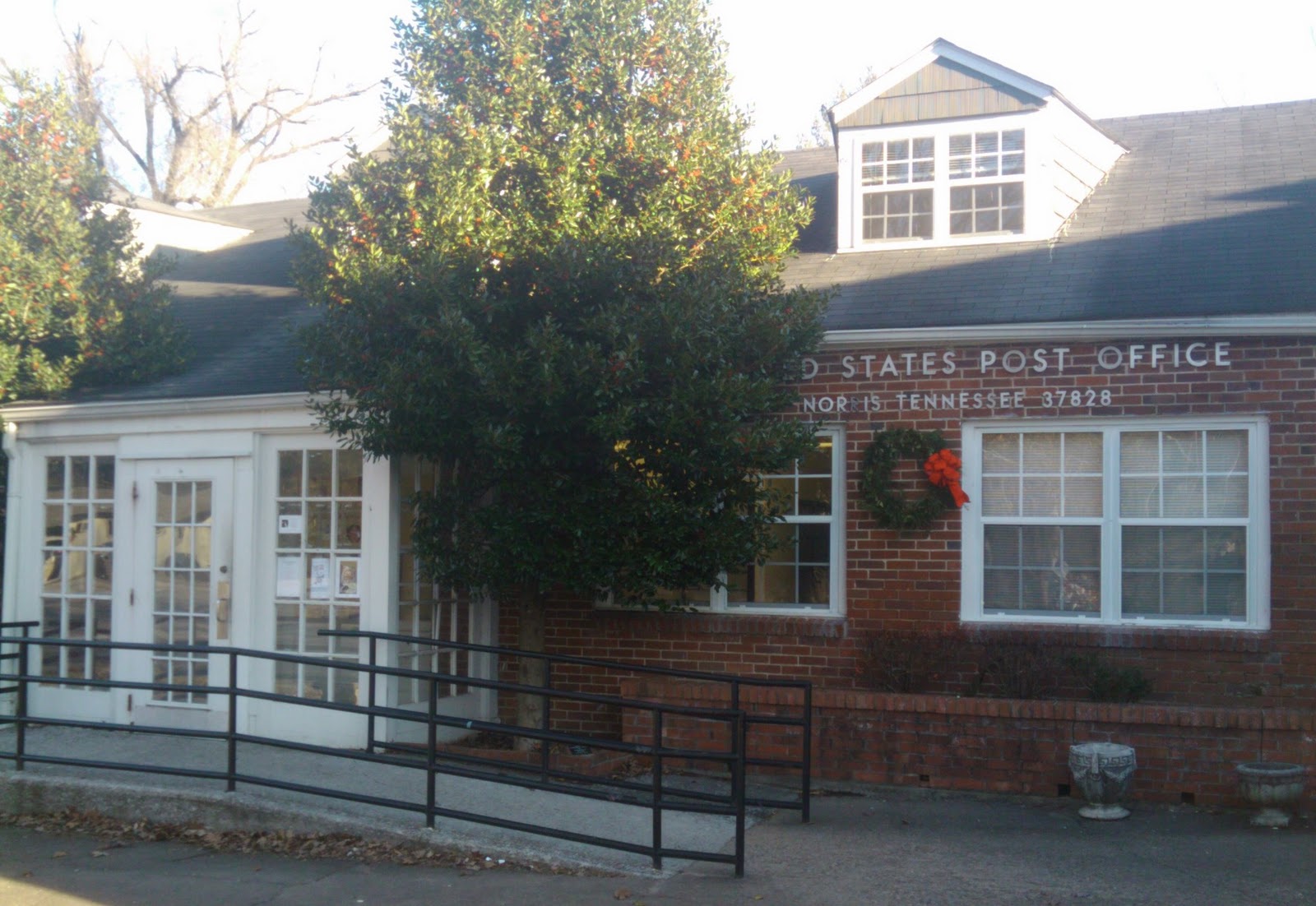
In the warmer months, we’ve walked to Archer’s, the local grocery store, and to the post office, located in the building next to Archer’s and Hensley Happenings, the local cafe.

the local grocery store--part of the town center
We see many people walking—on our road and throughout the community, either with their dogs, on errands, or out for some fresh air and exercise. Since it is a small town (population around 1,500), the destinations are limited, but it’s great to have the opportunity to walk to the center of town, enjoying the sights of history and nature along the way.

the post office--also part of the town center

Monday, January 23, 2012

Electricity for all

Last week, an afternoon thunderstorm knocked the power out at the house. I was working at the time, and although my laptop could run on battery for a short time, I depend on an Internet connection to connect to a remote work computer. The outage was short—only an hour—but it’s obvious how electricity is a necessity nowadays, and how easy it is to take for granted something that we depend on daily. I did some reading on the history of electricity in our area and discovered that less than 100 years ago, east Tennessee had no electricity.

The lack of electricity changed with the advent of the Tennessee Valley Authority (TVA), which is the nation’s largest public power provider. It was created as part of the New Deal in 1933 under President Franklin Roosevelt; it was one of the programs designed to bring the country out of the Great Depression, and aimed to address environmental, economic, and technological issues.

11/21/1934, Jersey City Journal; cartoon of President Roosevelt (source)
In the early 1900s, the Tennessee Valley was suffering: land was being farmed too hard and soil was eroding/depleting, crop yields were falling, farm incomes were shrinking, and 30% of the population was affected by malaria. Enter the TVA. Dams were built to generate energy from the region’s rivers, and with the introduction of electric lights, appliances, fertilizers, and new farming techniques, east Tennessee was modernized. Electricity made life easier and farms became more productive.

rural electrification:  before and after (source)
However, the TVA and Norris Dam were not without controversy. Around 15,000 families were displaced from their land and homes in the Norris Lake area. Racial discrimination persisted; many African Americans living in the region were available for work, but were not hired by the TVA. Local power companies felt the federal government should not be involved in private development and escalated a lawsuit to the Supreme Court. Despite the controversies, TVA dams were completed, and 75 years later in Norris, we’re using even more gadgets dependent upon electricity via the power of nature.

TVA dams in red (source)
For additional information, see the TVA website and the New Deal Network.

Thursday, December 22, 2011

It's raining, it's pouring

The past few weeks have been busy with end of the semester activities—final papers, tests, and presentations. The fall semester is over and now it’s time to enjoy the break and the holidays before classes begin again in January. There’s no snow on the ground yet, and with a forecast of rain and temperatures in the low 50s for the next five days, no chance for a snowy Christmas this year.

Speaking of rain, this fall was especially rainy. Not only did we observe many days with rain, but I recorded rainfall in a rain gauge for my fall semester Bionformatics class (bioinformatics, also known as environmental informatics, includes the collecting, linking, storage, organization, analysis, delivery, and application of biological data and information). One of our projects required us to record rainfall at our residence on a daily basis, and at the end of the semester, prepare a report with rainfall data, analysis, metadata, a data management plan, and conclusions.

my rain gauge, holding 3" of rain; the student research self emptying bucket on pole 
I installed my rain gauge on the side of the electrical/garbage wooden enclosure. It’s a wedge shaped plastic gauge, and is easy to remove for readings. The student researchers are also monitoring rainfall, but they are using a self emptying bucket with a sensor that sends measurements electronically. Their white bucket is installed on the utility pole, and can be seen in the background.

The total number of days in my study was 85, and 28% of the days monitored received rainfall. September 5th, the first day of recorded rainfall, happened to be during Tropical Storm Lee, and 6.10” of rain fell that day. September topped out at 9.86”. October’s total was lower at 4.92”, but November had much more rain than usual at 9.06”. The chart below compares the rainfall I recorded to the monthly normals (30 year averages based on the period of 1971-2000).


In the course of the project, I discovered the Tennessee Valley Authority (TVA) Region Precipitation website. The TVA has rain gauges throughout the region and uses the data to make water management decisions. I compared my data taken at the house with the measurements taken at the Norris Dam, and the rainfall amounts were very close.


In light of all the fall rain, the rainwater cistern for the house (it provides water for the clothes washer and toilet tank) was most likely never empty. It’s great to be living in a house where the rainwater is being reused and also in constant supply.

Wednesday, September 29, 2010

Ready.. Set..

Today was the last day of preparation before THE BIG DAY OF HOUSE DELIVERY (Clayton will be delivering the house on Thursday).

The dormer team has done it! After a lot of hard work and endurance through some small glitches in the system, the dormer is complete and ready for transplantation. Tomorrow evening, this group of fine craftsmen/women will deliver their masterpiece to its new resting place in Norris.

The masonry team has also arrived at its goal. 2 1/2 walls have been laid, and today the bond beam was reinforced and poured. Highlight of our day: because of our efficiency, we had some time before the concrete truck arrived, so we took the opportunity to visit the nearby Norris Dam. The weather was great, and the dam and its natural surroundings are incredibly beautiful! Everyone should go see it! In the visitors center, Andy Pittman and I had the opportunity to talk with a very nice lady that worked there. Turns out, she and her husband live in the Town of Norris, and he served as Mayor for several years. It was clear that they really love the way of life there when she told us that "Norris really is the best kept secret in all America!" We were also happy to hear that she and her husband are looking forward to coming to see the house.

Once the house is delivered to the site, our work continues. Next steps: the other two foundation walls will be laid, and the dormer will be placed onto the roof. I think we're all really looking forward to see all of this coming together.