Showing posts with label design. Show all posts

Sunday, September 2, 2012

Reflections

It’s hard to believe that our year of living in the New Norris House is over. During our time there, it was a bit like living in a lab; our energy and water usage were monitored, and we tested the design and systems installed in the house. Although we’ve moved out, there are several things we grew to appreciate while living there that will stay with us.

Natural light 
We loved the natural light that filled the house during daylight hours. The roller shades over all the windows block direct sunlight and help keep the house cool, but don’t block the light entirely like blinds or curtains would. Even on cloudy days, the skylight in the living area let in enough light so we didn’t need to turn on the kitchen or loft lights until dusk. The skylight and kitchen window are two features in the house I miss the most.
the windows, skylight, french doors all let in plenty of light (source)
Design
Initially, we weren’t sure how scaling down to 768 square feet would work—would we be able to fit our things in the house, and would it feel too small? We discovered that although the footprint of a living space may be smaller, it can be more functional than a larger space because of its design. The house’s layout provided small private areas (bedroom and bathroom) with a large open living space where most of our time was spent (the kitchen and swing space). The house has ample storage, with cabinets in all rooms and bookshelves in the swing space and loft. While the loft space didn’t make the footprint of the house seem larger, it provided a separate area for relaxation.

a small footprint of great design (source)
Rainwater use
The rainwater cistern and filtration/purification system was explained to us when we first moved in; rainwater is collected from the roof into a cistern, then purified and used in the house for washing clothes and filling the toilet tank. I was a bit skeptical about how well the purified rainwater would work in the washer, but it did the job just as well as fresh water. The washer water had a leaf-like smell to it, but was noticeable only when opening the washer door to transfer items to the dryer. After being in the house for a few months, I found myself looking forward to rain, knowing it would keep the cistern full and provide water inside. Before living in the house, I hadn’t given any thought to repurposing rainwater; the firsthand experience of being able to reuse water has made me more mindful about how much fresh water I use daily.

rainwater on the back porch railing (source)
After moving into the house, we were asked if we thought our quality of life would be affected by living in a smaller and energy efficient space. Living in the house affected us positively, with design and systems we wouldn’t have experienced otherwise. Much like the original residents of Norris who were introduced to electricity in their homes 75 years ago, we had the opportunity to experience the latest in energy efficient and sustainable systems, in the same community where electricity came to Tennessee. While the house looks a bit different than the first Norris cottages and the use of electricity has expanded to support computers and telecommuting, the experience we had there was educational, helping inform us about design and energy choices we can make wherever we might live in the future.

Thursday, April 19, 2012

Water features

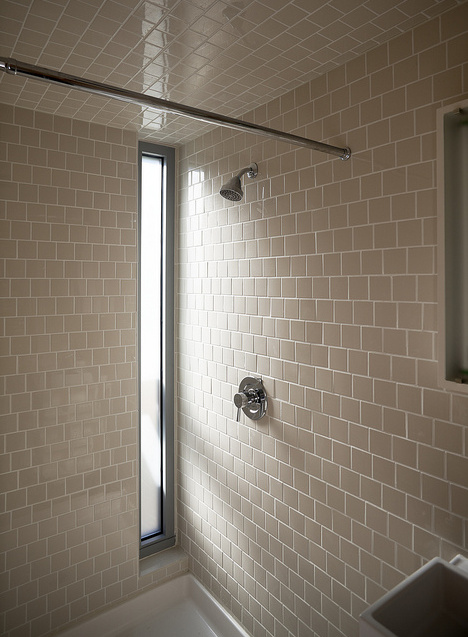
One of the rooms in the house that hasn’t been mentioned often—yet gets daily use—is the bathroom. With the bathroom being the top water user in the house, the water features installed here are helping conserve water in several ways.

The New Norris House was built with a rainwater cistern and purification system which delivers harvested and treated rainwater to the toilet tank (and to the clothes washer and outside hose bibs as well). Systems like this aren’t common in the U.S., and the system here is being used under a special permit. According to the EPA, one toilet can use 27% of a household’s daily water, and older toilets use between 3.5 to 7 gallons of water per flush. It makes sense to use rainwater instead of fresh water for flushing given those numbers, since fresh water is a finite resource and harvested rainwater, a naturally replenished resource, works just as well.

rainwater cistern (gray container) and purification system (blue cylinders)
The toilet also has the water saving feature of a low flow/dual flush system (Kohler Persuade model). Either .8 or 1.6 gallons are used per flush depending on which button is pressed. This means the rainwater isn’t used up quite as quickly, but if we lived in a house with standard plumbing, this toilet would be using less pure drinking water for flushing as well. Because I’m living in a house where the rainwater is harvested, treated, and reused, I’ve become more aware of water usage and potential ways to adjust no matter where we live next.


Another bathroom water feature that’s probably more common is low flow fixtures. The shower head and sink faucet are both low flow. “Low flow? I don’t like the sound of that.” Admittedly, neither of us are huge fans of the lack of water pressure with the low flow shower head, but because it can cut water consumption by half, it also makes sense to have it installed in the bathroom. And, to save energy on heating costs, the water is heated with a solar water heating and tankless system.


Besides the water features, the design of the bathroom is worth noting. The same design principles used in the house were applied to the bathroom as well; it’s small but makes efficient use of the space. The room is almost 10’ long, with the stall shower at one end, the sink in the middle, and the toilet at the other end. At its widest on the shower end, the room is 3.5’ wide and at its narrowest on the toilet end is 2.5’ wide. Like the bedroom, it has a pocket door to maximize space. For storage, there is a medicine cabinet, a cabinet under the sink, small shelves on the side of the sink, and a shelving unit above the toilet.


Although it’s a small room, I’ve learned quite a bit about conserving water and energy from living in the house. You can also learn more about our project at www.thenewnorrishouse.com.